What is Computerized Auto Diagnosis? A Complete Guide to Modern Car Tech

What if that glowing "Check Engine" light wasn't a signal to empty your savings account, but a precise map to the exact component that needs attention? Most drivers feel a sudden knot of anxiety when a dashboard warning appears. You might worry about being overcharged for mystery repairs or feel confused by the complex electronics hidden under the hood. It's a common frustration, and you're certainly not alone in wanting more transparency and honesty from your mechanic.
This guide explores how professional computerized auto diagnosis serves as a truth-telling tool for your vehicle. With services like those offered by Humbers All Car, modern technicians use advanced protocols like Unified Diagnostic Services (UDS) and Diagnostics over IP (DoIP) to pinpoint hidden engine issues with surgical precision. This technology saves you thousands of dollars by eliminating the guesswork that often leads to unnecessary part replacements. You'll discover exactly how the diagnostic process works, which systems are monitored under modern standards like the upcoming Euro 7 regulations, and how to use this information to speak confidently with any technician. We'll turn that dashboard mystery into a clear, actionable plan to restore your peace of mind and vehicle reliability.
Table of Contents
Understanding Computerized Auto Diagnosis: The Basics
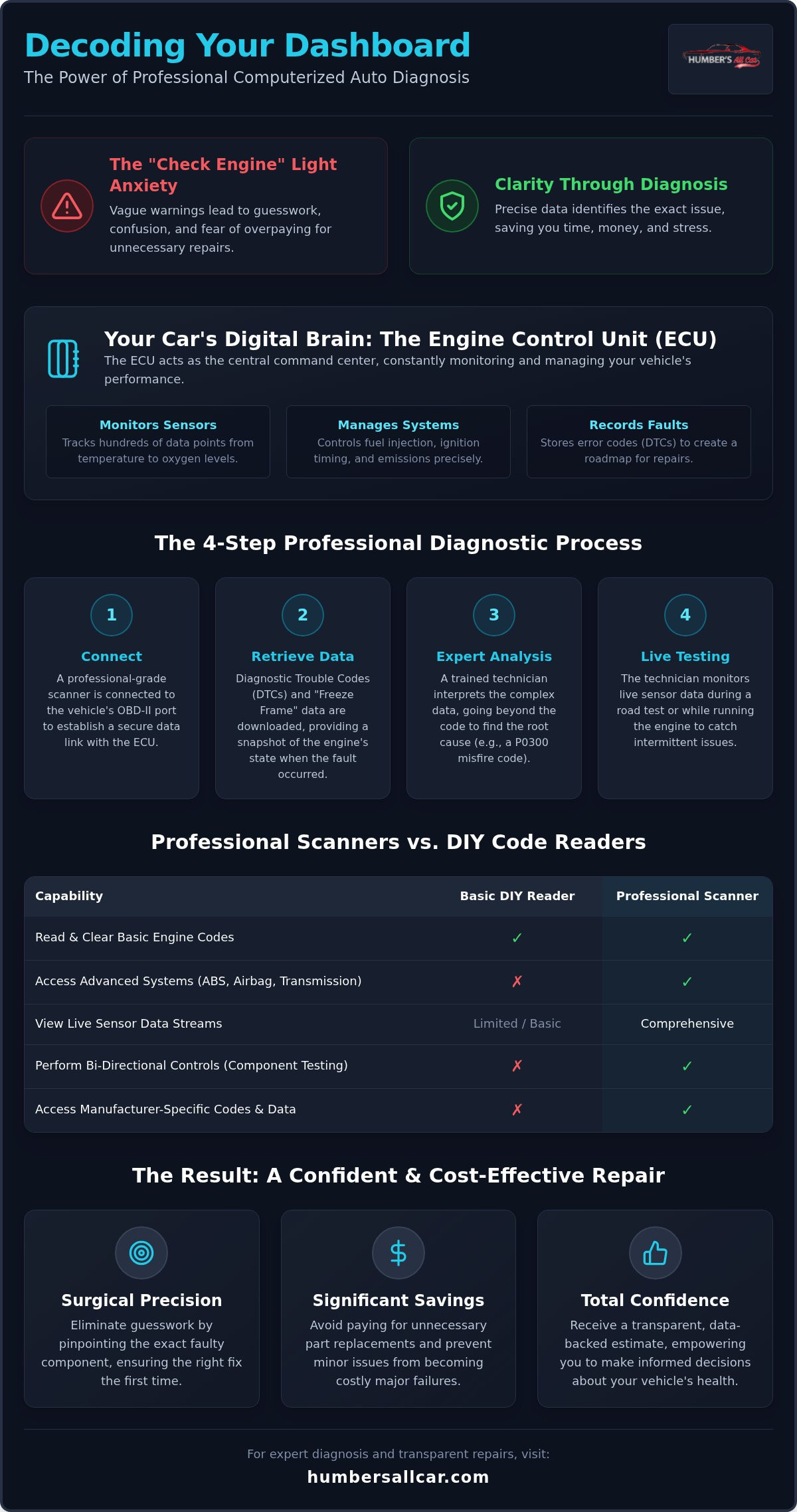
Think of a professional diagnóstico computarizado de auto as a comprehensive digital health check for your vehicle. It's far more than just plugging in a tool and reading a number. This process involves a deep dive into the Engine Control Unit (ECU), which functions as your car's brain. The ECU constantly monitors hundreds of sensors to manage fuel injection, ignition timing, and emissions. When something goes wrong, the ECU records a specific data point, providing a roadmap for the repair process.
Since 1996, every car sold in the United States has been required to follow a standardized protocol called On-Board Diagnostics (OBD). This universal language allows technicians to access the vehicle's internal computer regardless of the make or model. While a dashboard warning light tells you there's a problem, a deep system scan explains the "why" behind the alert. It provides the technical clarity needed to move from guessing to fixing.
The Evolution of Vehicle Electronics
The transition from mechanical parts to digital systems has been massive. In the past, mechanics tuned carburetors by ear and adjusted timing with manual tools. Modern vehicles have replaced those mechanical links with sophisticated digital sensors. Today, computers manage everything from the precise amount of fuel entering the cylinders to the deployment of safety systems. Manual troubleshooting is no longer enough for these complex machines. You can't hear a failing mass airflow sensor, but a digital scan captures its erratic behavior instantly. This technological shift requires a craftsman's eye and an expert's technical knowledge to ensure every component works in perfect harmony.
Why the Check Engine Light is Just the Beginning
A "Check Engine" light is merely a starting point. It's the car's way of saying it needs help, but it's often vague. A professional diagnostic scan looks deeper by analyzing real-time data streams and historical logs. We look for "active codes" that indicate a current failure and "stored codes" that reveal intermittent issues. This early detection is vital. Catching a small sensor error today can prevent a total engine failure tomorrow. By monitoring performance while the car is running, we can see exactly how the engine breathes and fires. This level of detail allows us to provide a transparent repair estimate, ensuring you only pay for the work your vehicle actually needs. This approach builds trust and ensures your car remains a reliable partner on the road.
How the Diagnostic Process Works Step-by-Step
The diagnostic process is a methodical sequence of events designed to eliminate guesswork. It begins the moment a technician connects a professional-grade scanner to the vehicle's communication port. This isn't just a simple plug-and-play action. It's the start of a deep dialogue between our equipment and your car's complex internal logic. By following a structured path, we ensure that every hidden issue is identified before any tools touch the engine.
Connecting to Your Vehicle's Brain
The diagnostic port, or OBD-II connector, is typically located under the dashboard on the driver's side. Once connected, the scanner establishes a secure link with the ECU. We ensure a clean, stable data connection to avoid signal interference that could lead to false readings. This step allows us to see exactly what the car's sensors are reporting in real-time. For more background on these standards, you can review this OBD II Systems Fact Sheet which outlines the regulatory requirements for these interfaces.
After the connection is established, the technician performs the following critical steps:
Retrieving DTCs: We download the alphanumeric Diagnostic Trouble Codes stored in the computer's memory to see which systems reported an error.
Analyzing Freeze Frame Data: This provides a snapshot of the engine's conditions, such as RPM, temperature, and fuel trim, at the exact millisecond the fault occurred.
Real-Time Testing: We monitor live sensor outputs while the engine is running or during a road test to catch intermittent glitches that only happen under specific driving conditions.
Interpreting Diagnostic Trouble Codes (DTCs)
A code like 'P0300' indicates a random engine misfire. However, it doesn't tell us exactly why the misfire is happening. The cause could be a worn spark plug, a failing fuel injector, or even a vacuum leak. This is where the technician's expertise becomes essential. We use the code as a starting point to perform targeted mechanical tests. A diagnóstico computarizado de auto provides the evidence, but the mechanic provides the final verdict. We verify the computer's findings through physical inspection to ensure the repair is accurate and cost-effective.
By following this structured approach, we provide clarity instead of confusion. If your vehicle is behaving strangely, getting a professional vehicle diagnostic and repair estimate is the fastest way to restore your peace of mind and get back on the road safely.
Key Systems Monitored by Computerized Diagnosis
Modern vehicles are complex ecosystems of interconnected parts. A thorough diagnóstico computarizado de auto provides a window into these systems, allowing technicians to verify the health of components that are otherwise invisible. While most people associate scans with the engine, the scope of a professional diagnostic tool extends to the transmission, safety modules, and even the air conditioning. This wide-reaching coverage ensures that no hidden issue goes unnoticed during a routine check.
Powertrain and Fuel System Analysis
Powertrain diagnostics are the core of engine health. Your car's computer monitors the fuel-to-air ratio constantly to ensure you're getting the best possible gas mileage. If this ratio is off, the engine might run "lean" or "rich," leading to sluggish performance or high fuel costs. The system also detects subtle misfires that you might not feel yet. Identifying these early protects the catalytic converter and prevents expensive engine damage. This level of monitoring is a standard feature of the On-Board Diagnostic II system, which keeps your vehicle running within its designed efficiency parameters.
Beyond the engine, the transmission relies on digital sensor synchronization to function correctly. The computer monitors shift points and internal fluid pressure to ensure every gear change is smooth and efficient. If a sensor loses sync, the car might jerk or hesitate during acceleration. Early digital detection allows us to address these issues before they turn into a complete transmission failure. It's about maintaining the rhythm of the vehicle through precise data.
Braking and Climate Control Systems
Safety systems are just as critical as the powertrain. The computer monitors Anti-lock Braking System (ABS) sensors to ensure your car can stop safely in an emergency. It also checks airbag modules and electronic stability control to keep you protected on the road. If a sensor fails, the system alerts you immediately, often before you notice a change in pedal feel. This proactive approach to safety is why digital scans are indispensable for modern car owners.
Even your comfort is managed digitally. We can diagnose A/C compressor issues by reading digital signals from the climate control module, pinpointing leaks or electrical failures without tearing the dashboard apart. Understanding these systems helps you stay in control of your vehicle's maintenance. For a deeper look at how these technologies are applied locally, see our Professional Vehicle Diagnostics in North Fort Myers: The Complete 2026 Guide. This comprehensive approach ensures that every part of your car, from the brakes to the exhaust, receives the meticulous attention it deserves.
Professional Scanners vs. DIY Code Readers
Many drivers carry a basic code reader in their glovebox, but there is a massive gap between reading a code and performing a full diagnóstico computarizado de auto. Cheap consumer devices usually only access generic emissions data. In contrast, our professional tools provide a deeper look into manufacturer-specific sub-systems. This includes the transmission, body control modules, and safety systems that basic readers simply ignore. Accuracy matters when your vehicle's reliability is on the line.
Another critical difference is bi-directional control. Our professional equipment allows us to command specific components to activate. For instance, we can tell the A/C compressor to turn on or pulse a fuel injector during a test. This feature lets us isolate whether the part itself has failed or if the issue lies within the wiring or the ECU. Without this capability, a mechanic is just guessing. Professional tools also undergo regular calibration to ensure the data we receive is 100% reliable.
Why a Code is Not a Diagnosis
A trouble code points to a circuit, not necessarily a specific part. If a sensor reports a low voltage, the sensor itself might be fine. The real culprit could be a corroded wire, a blown fuse, or a vacuum leak elsewhere in the system. This is why the "parts cannon" habit of replacing every part mentioned by a code is so expensive and ineffective. Our technicians use the computer data as a starting point for a physical inspection. We verify the failure before suggesting a fix, which prevents you from paying for unnecessary repairs.
The Value of Professional-Grade Equipment
Professional gear accesses long-term fuel trims and historical data logs. This context is vital for solving intermittent problems that don't always trigger a light. We can see how the car has performed over thousands of miles, not just in the moment of the scan. Additionally, many modern repairs require software updates through the diagnostic interface. Basic DIY tools can't perform these flashes, leaving your car's brain running on outdated logic. A certified report from an expert gives you the full picture of your car's health.
If you are tired of guessing which part to replace next, schedule a vehicle diagnostic and repair estimate today to get the right answer the first time.
Data to Action: The Humbers All Car Diagnostic Approach
At Humbers All Car, we believe data is only as good as the technician interpreting it. We bridge the gap between digital precision and hands-on mechanical skill by integrating every diagnóstico computarizado de auto with our expert engine and brake repair services. This evidence-based approach ensures that we aren't just replacing parts. We're solving the root cause of the problem. Our commitment to meticulous craftsmanship means we treat every vehicle with the individualized attention it deserves, ensuring your car returns to the road in peak condition.
Precision Diagnostics in North Fort Myers
Florida's climate presents unique challenges for modern vehicle electronics. High humidity and intense heat often cause automotive electrical connectors to oxidize or fail prematurely. These environmental factors can trigger "ghost" codes or intermittent sensor issues that are difficult to track without professional equipment. Our team understands these local conditions. We specifically look for heat-related sensor degradation that common scanners might miss. By performing regular diagnostic check-ups, we catch these small electrical faults before they escalate into major mechanical failures. Booking your diagnostic appointment at Humbers All Car is a proactive way to protect your vehicle from the harsh Florida elements.
Regular scans are particularly vital for maintaining safety systems. Since sensors for your ABS and stability control are exposed to road debris and moisture, they're often the first to fail. We use our advanced scanners to verify that these safety modules are communicating correctly with the ECU. This level of thoroughness provides the peace of mind that comes from knowing your vehicle is truly reliable.
From Scan to Detailed Repair Estimate
We believe in total transparency. After completing a scan, we translate complex technical data into a clear, actionable plan. You won't just receive a list of codes. You'll receive a detailed repair estimate that explains exactly what your vehicle needs and why. We take the time to walk you through the diagnostic findings so you can make informed decisions about your car's maintenance. This direct communication eliminates the anxiety often associated with mystery repairs.
Our legacy of trust in North Fort Myers began when we were founded in 2018. Since then, we've positioned ourselves as a high-standard alternative to impersonal competitors by focusing on honesty and professional excellence. Whether we're performing a complex engine repair or a routine brake service, our goal is to restore your vehicle's performance through precision and care. When you choose us, you're choosing a partner dedicated to keeping your vehicle safe and efficient for years to come.
Restore Your Vehicle's Performance and Reliability
Understanding the digital health of your car is the most effective way to prevent costly mechanical failures. A professional diagnóstico computarizado de auto provides the technical clarity you need to make smart maintenance decisions. By moving beyond simple code reading and utilizing deep system analysis, you ensure that every repair is both necessary and precise. This methodical approach protects your engine and saves you from the frustration of mystery repairs.
At Humbers All Car, we've been serving the North Fort Myers community as expert engine repair specialists since 2018. We take pride in delivering detailed, transparent repair estimates that turn complex data into clear solutions. Our team combines elite technical knowledge with the personalized care of a local partner. Don't let a dashboard warning light create unnecessary stress. Schedule your professional computerized diagnosis at Humbers All Car today. We're here to keep you moving safely on the road.
Common Questions About Computerized Auto Diagnosis
Is a computerized auto diagnosis necessary for older cars?
Yes, any vehicle manufactured after 1996 is equipped with an OBD-II port that requires digital analysis. Even if your car feels purely mechanical, it relies on an Engine Control Unit to manage fuel and emissions. Performing a scan on an older high-mileage vehicle is actually one of the best ways to extend its lifespan. It helps us identify aging sensors before they leave you stranded.
How much does a professional computerized diagnosis cost in North Fort Myers?
The cost of a professional diagnostic service depends on the complexity of your vehicle's electronics and the time required for a technician to interpret the data. A basic code pull is different from a deep system analysis that monitors live data streams. We always provide a clear explanation of the labor involved and a detailed estimate before moving forward with any necessary repairs.
Can a computer scan detect transmission problems before they start?
Modern scanners identify subtle irregularities in shift timing and internal fluid pressure long before you feel a physical slip. The computer monitors how quickly the transmission responds to engine commands. If these numbers fall outside of the factory specifications, the system flags a potential issue. Catching these digital warnings early allows for minor adjustments that prevent a total and expensive transmission failure.
How long does a full vehicle diagnostic scan typically take?
A thorough diagnostic session usually takes between 45 and 60 minutes. This window allows our technicians to connect professional-grade equipment, download all stored codes, and analyze real-time sensor performance. If the problem is intermittent, we might need a bit more time for a road test. We focus on being methodical and precise rather than rushing through the data to ensure your car is safe.
Will a computerized diagnosis tell me exactly which part to replace?
No, the scanner identifies a malfunctioning circuit or system rather than a specific part. A diagnóstico computarizado de auto acts as a highly accurate roadmap for our technicians. For instance, a code for a misfire doesn't always mean you need new spark plugs. It could be a failing fuel injector or a vacuum leak. We use the data to perform targeted physical inspections and find the real culprit.
What happens if the computer scan doesn't find any error codes?
If the scan comes back clean but your car is still acting up, we shift our focus to purely mechanical components. Issues like worn suspension bushings, exhaust leaks, or cooling system clogs don't always trigger a sensor. In these cases, our experience as meticulous craftsmen becomes your biggest advantage. We use the scan to rule out electronic failures so we can quickly locate the physical cause of the trouble.
Can heat and humidity in North Fort Myers trigger false sensor readings?
Florida's intense humidity often causes corrosion on electrical connectors, which can lead to "ghost" codes or false readings. Intense heat also degrades sensor housing over time. Our diagnóstico computarizado de auto helps us distinguish between a component that has actually failed and one that just has a poor connection. We specifically check for these local environmental factors during every diagnostic session to save you money on parts.
How often should I have a diagnostic scan performed on my vehicle?
We recommend a professional diagnostic check-up at least once a year as part of your routine maintenance. It's also wise to schedule a scan before a long road trip or if you notice a slight dip in your fuel economy. Regular monitoring allows us to see long-term performance trends. This proactive approach helps us catch small issues before they ever turn into a "Check Engine" light on your dashboard.
Comments